



What to know
- Travel from Democratic Republic of the Congo (DRC): Travelers, including U.S. citizens and U.S. nationals, who have been in DRC within 21 days before departure will not be allowed to board commercial flights with U.S. destinations. These travelers should plan to remain outside the United States for at least 21 days after they leave DRC. If they have been in outbreak-affected provinces in DRC, they may be subject to additional travel requirements from local authorities before they leave DRC.
- Travel from Uganda or South Sudan: U.S. citizens and U.S. nationals who have been present in Uganda or South Sudan (and not present in DRC) within 21 days before arrival in the United States will have their air travel routed through designated U.S. airports for public health entry screening.
Background
To reduce the risk of Ebola importation into the United States, U.S. entry for travelers who were recently in the Democratic Republic of Congo (DRC) is temporarily restricted. Travelers, including Americans, who have been in DRC within 21 days of their flight will not be allowed to board commercial flights with U.S. destinations. All U.S. citizens and U.S. nationals who have been in DRC should plan to remain outside DRC for 21 days before entering the United States. This includes all passengers with an intermediate stop in DRC or on multi-stop itineraries via DRC regardless of whether they disembark or stay on the airplane.
U.S. citizens and U.S. nationals who have been present in Uganda or South Sudan (and not present in DRC) within 21 days of arrival in the United States must only enter through designated airports for enhanced screening.
This process is in addition to CDC's renewed July 13 order, under 42 CFR 71.40, that continued the temporary entry restrictions to the United States for certain categories of travelers after they were in DRC, Uganda, or South Sudan.
More information for travelers
Americans who need consular assistance can visit Additional Consular Information for Americans Regarding the Ebola Outbreak or call the Department of State:
- From U.S. and Canada: +1-888-407-4747
- All other locations: +1-202-501-4444
Before you travel to the U.S.
Travel from DRC
The United States has temporary travel restrictions for people, including U.S. citizens and U.S. nationals, who have recently been in DRC.
If you have been in DRC during the previous 21 days:
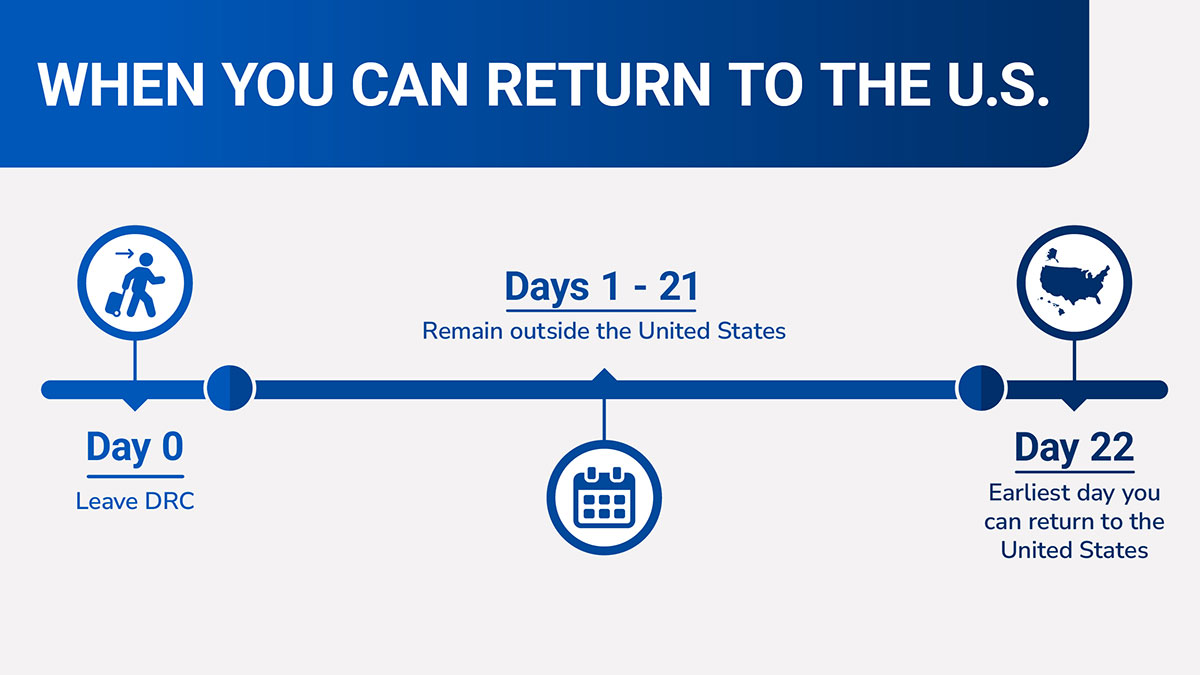
- You will not be permitted to board a commercial flight to the United States until 21 days have passed since you left DRC. This applies even if you were on an airplane that stopped at an airport in DRC regardless of whether you disembarked or stayed on the airplane.
- You should plan to remain outside the United States until at least 21 days have passed since you left DRC.
IMPORTANT
- Travelers who have been in outbreak provinces in the DRC may have specific travel requirements from local DRC authorities.
- Always check entry requirements of any country you plan to visit during the 21 days after you leave DRC.
Use this graphic as a reference for when you can return to the United States.
Travel from South Sudan or Uganda
The United States has temporary travel restrictions for certain travelers, including U.S. lawful permanent residents (Green Card holders), who have recently been in Uganda or South Sudan.
Travel by U.S. citizens and nationals who have been in South Sudan or Uganda is not restricted.
For travelers who are permitted to enter the United States:
- Your travel will be rerouted to a designated U.S. airport for public health entry screening.
- This requirement applies even if you only traveled through South Sudan or Uganda on a connecting flight.
- Airlines will work with affected travelers to rebook flights, if needed.
After You Arrive in the U.S.
Travelers who have been in South Sudan or Uganda in the past 21 days and are permitted to enter the U.S. will undergo public health entry screening at one of the following U.S. airports:
- Washington-Dulles International Airport (IAD) outside Washington, D.C.
- Hartsfield-Jackson Atlanta International Airport (ATL) in Atlanta, Georgia
- George Bush Intercontinental Airport (IAH) in Houston, Texas
- John F. Kennedy International Airport (JFK) in New York, New York
During entry screening, travelers will:
- Be escorted to a screening area
- Complete a brief questionnaire about travel history and symptoms, if any
- Have their temperature checked
- Be observed for signs of illness by CDC staff
- Be enrolled in automated text messages from CDC to remind them to monitor their health for 21 days after they left the affected country.
Some travelers will have an additional public health assessment based on their area of travel and activities while in the affected country. CDC will also share travelers' contact information with state or local public health authorities, as needed, for follow-up and support.
If you do not have symptoms
You will receive information about monitoring your health for 21 days after leaving the affected country. Most travelers without symptoms will continue to their final destination after public health entry screening.
If you have symptoms
If you have a fever or other symptoms consistent with Ebola, a CDC public health medical officer will conduct an additional evaluation. If Ebola is suspected, you will be transferred to a hospital for medical evaluation, isolation, and care.
Steps to take after travel
- Monitor your healthMonitor your health for 21 days after you leave DRC,* South Sudan or Uganda. After you arrive in the U.S., CDC will send you automated text messages reminding you to watch for symptoms and to take action if you get sick.
- Take your temperature
If you were in DRC, take your temperature every day and again if you feel sick.
If you were in South Sudan or Uganda, take your temperature if you feel sick.
- Watch for symptoms
Watch for possible symptoms of Ebola such as fever (100.4°F/38°C or higher) or feeling feverish, headache or body aches, rash, weakness or tiredness, sore throat, diarrhea, vomiting, stomach pain, or unexplained bleeding or bruising (a late stage of illness).
*People who have been granted an exception to travel to the United States.
What to do if you get sick
If you develop any signs or symptoms that might be Ebola:
- Separate yourself from others (isolate). Stay in a room by yourself and don't share a bathroom with others.
- Call your local health department (if you are in the United States) or health officials where you are located for advice about medical care. Tell the health department about your recent travel from a country with risk of Ebola and your symptoms. They can identify the best healthcare facility for you to go to, if needed. Health department staff can also help the facility prepare to provide care for you and take any health precautions needed. Follow all their instructions.
- Do not travel while sick. Travel only when you have been cleared by a doctor or health official.
If you need urgent medical care and you can't reach your health department right away
Resources
- Ebola Disease Basics | CDC
- Ebola Outbreak: Current Situation | CDC
- History of Ebola Outbreaks | CDC
- Consular Information for Americans Regarding the Ebola Outbreak | Dept of State
- 24-hour Health Department Contacts | CSTE
This page was last updated on this date. Updates may include minor edits, image changes, or other modifications to page content.
The information on this page was last reviewed by subject matter experts to ensure accuracy.